


Hoshigaki, the Japanese Tradition of Dried Persimmons

Persimmons are one of those novelty fruits I had heard about but never really explored until adulthood.
Featuring: Persimmon varieties, Hoshigaki Tradition, Kurogaki wood, Wagashi, Persimmon leaf tea, Astringent vs non-astringent fruit, natural sugar bloom (shisō), Kakinoha sushi, Persimmon Recipes

An impossibly orange fruit that should be eaten when fully ripe, otherwise, you will regret it immediately. If you’ve ever tasted an unripe persimmon, you know the sensation: your tongue turns to sandpaper and panic sets in. It won’t hurt you, but it is very unpleasant. A ripe persimmon, by contrast, should be soft to the touch, sweet and jammy inside, and almost custard-like.
Though there are said to be over a thousand persimmon varieties across the world, these are some of the most commonly encountered in both Asian and Western markets. Kaki is the general Japanese word for persimmon, but there are two main categories of persimmons: astringent and non-astringent. Amagaki refers to non-astringent varieties: the flatter, rounder fruits like Fuyū and Jirō are the most common, and can be eaten while still somewhat firm - they are sweet and sliceable. Astringent persimmons (shibugaki), most common ones being Hachiya, Saijo or Taneshi, must be fully softened or processed before eating and are often used for drying by way of the traditional Japanese method, Hoshigaki.

Persimmon Trees
Persimmon trees are a deciduous tree (meaning it has leaves dry up and fall off annually) which are found all over the world, but are particularly common in Japanese countrysides, found alone in backyards, or in cultivated fields in areas of Japan like Nara, Shizuoka, Fukuoka and Wakayama Prefectures.
Persimmon blossoms are small and fragrant, with creamy white or pale yellow thick-petals on flowers that appear in late spring or early summer. Each tree produces male (clustered) or female (single) flowers. Persimmons are often referred to as a “first frost fruit.” They hang on the tree long after the leaves have fallen, sometimes persisting through the first snowfall. While they can ripen off the tree in kitchens or markets, the visual of glowing orange fruit against bare branches is part of their magic. Here in Japan, we were still seeing the trees with fruits hanging into late December.

Hoshigaki - Dried Persimmon
Because astringent persimmons cannot be eaten raw, hoshigaki dried persimmons developed as a preservation method. The process begins with firm, slightly ripened fruit, harvested with a short piece of stem intact. Each persimmon is carefully peeled and hung by string in a well-ventilated space.
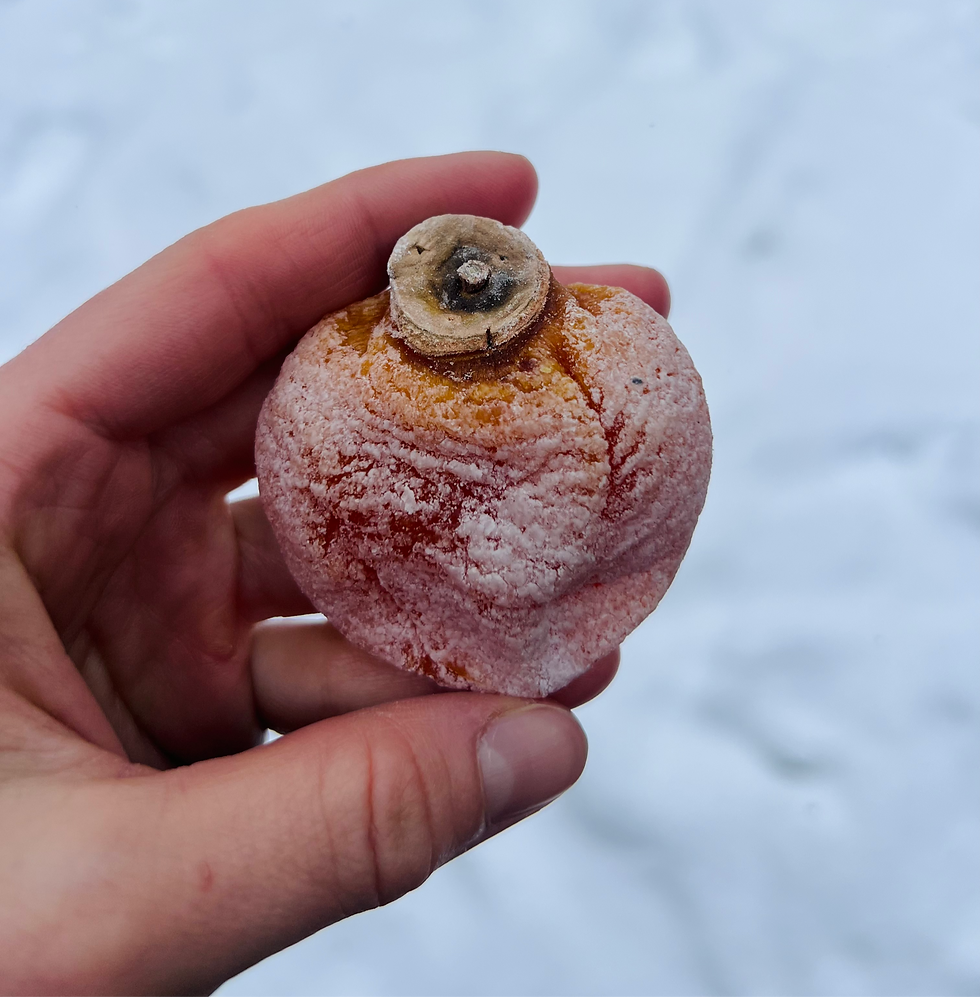
Over the course of several weeks (sometimes up three months), the fruit dries slowly. During this time, it is gently massaged by hand to redistribute sugars and soften the interior. As the outside of the persimmon cures, a natural bloom of sugar rises to the surface, forming a powdery white coating. This crystalline bloom is called shisō (しそう, with a long “o”), not to be confused with the green herb shiso (しそ).
Shisō gives hoshigaki its signature sweetness and is prized in wagashi, traditional Japanese confections. This frosty sugar on the outside gives a second meaning to “first frost fruit”.
Other Uses of the Persimmon
Persimmons extend far beyond the fruit itself. Persimmon leaf tea (kaki no ha-cha) is a naturally caffeine-free, vitamin-C–rich tea. Kurogaki, or black persimmon wood, is highly valued for fine furniture and tea ceremony utensils. The tannin-rich juice of astringent persimmons has historically been used in dyes, inks, and waterproofing.
Nara Prefecture you can find a regional specialty: kakinoha sushi is sushi which is wrapped in persimmon leaves. Persimmon trees are also associated with good spirits and longevity, and strings of persimmons are traditionally hung at New Year for good fortune.

Cooking With Persimmons
Ripe persimmons are incredibly versatile. Fuyū or can be sliced while just firm or eaten spoon-soft at peak ripeness. I often eat them when super ripe simply with a spoon for dessert, or spread over buttered toasted bread. I have used them sliced in chunks for salads, layered onto cakes, baked into sweet breads, or as toppings for panna cotta, cheesecake, or breakfast porridge. You can also blend ripe persimmon fruit with cocoa powder, then chill in a glass and serve as a delicious healthy chocolate pudding!
If you accidentally cut into an unripe persimmon, all is not lost. Stewing it into a jam or freezing it can reduce astringency, though these methods don’t quite compare to the fruit at proper ripeness.

Spiced Polenta + Pumpkin Cake with Persimmons
This is a perfectly winter recipe for a spongy dessert cake or sweet bite for breakfast. It is gluten free, and some might even say healthy.
Served 10-12 guests
Ingredients:
375g Pumpkin Puree. Roast your sugar-pie pumpkins until tender. Remove the seeds before or after, honestly it doesn’t matter to me. Scoop the soft pumpkin from the shell after cooling and blend until smooth. Throw your pumpkin debris into your compost heap for next year’s pumpkins.
100g Honey or Coconut Sugar
75g Butter or Olive Oil
330ml (11oz) Milk or alt Milk
4 Eggs, room temperature (makes it easier to mix)
5g (1 ts) Vanilla Extract
8g (1ts) Ground Cinnamon
2g (1/4 ts) Grated Nutmeg
30ml (1 oz) Rum
150g Corn Flour or Polenta, finely ground
4g (1 ts) Baking Soda
2g (1/2 ts) Baking Powder
3g (1/2 ts) Salt
Method:
Preheat oven to 350 °F or 176°C, spray a cake pan with non-stick spray or butter. Dust with cornflour and tap out any extra in the pan.
Wet batter: Cream your fat (butter or olive oil) with your sweetened (honey or sugar). Add in the milk and eggs, mixing well to incorporate, then mix in the rum and vanilla.
Dry: Mix the corn flour with the spices, baking powder, baking soda and salt.
Mix the wet mixture into the dry, mixing well to incorporate until smooth.
Pour into the sprayed cake pan dusted with corn flour.
Bake until toothpick/cake tester comes out clean when stuck into the middle of the cake. Let cool on a rack. Rim the edge of the pan with an offset spatula or dull knife to loosen the edge, and invert gently onto a plate.
To serve, slice a ripe fuyū like a tomato and lay over the top. Or if you have Hachiya persimmon, spoon a generous portion on top of each cake. Dust with ground cinnamon, and a dollop of whipped cream if you so choose!
Cheers,
Abigail


Comments